

Specials Diversify: A Broader Market Takes Shape



The specials market entered the second half of 2026 larger, more global and increasingly diverse. More than 14,000 securities generated lending fees above 500 basis points in Q3, with $1.79 billion in revenue across Asia, North America and EMEA. But beneath those headline numbers, the regional picture has shifted sharply: Asia has emerged as the largest source of specials revenue, North America has seen revenues retreat despite higher overall lending balances, and EMEA continues to broaden from a smaller base. This report examines what is driving those differences, which securities are generating the most revenue, and the catalysts that could shape the market into year-end.
Health check on the specials market
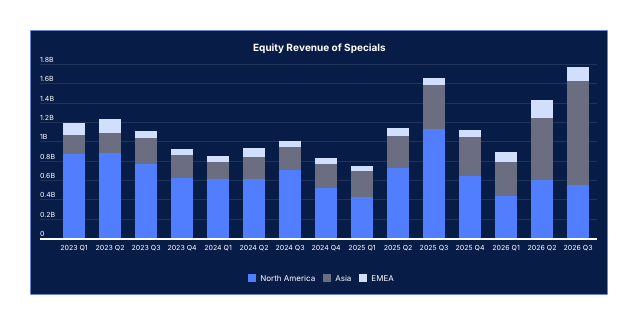
Specials, defined here as securities with an average lender-to-broker fee above 500 bps, earned $1.79 billion across the three major regions in Q3 2026, up 7% over Q3 2025. Asia produced 60% of that revenue, North America 32% and EMEA 8%. In the same period last year, Asia produced 28%, North America 68% and EMEA 4% of the $1.65 billion generated by specials.
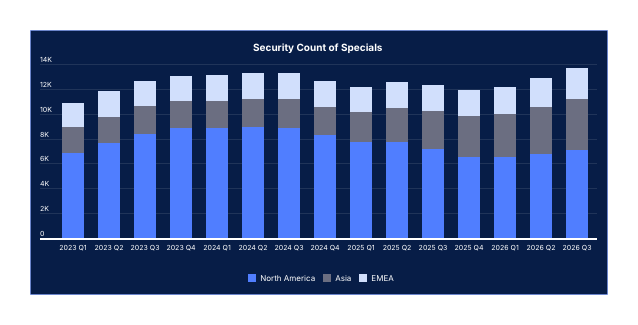
The count of specials is at a record 14,156 across the three regions, above the previous high of 13,740 in Q3 2024. Asia has risen for seven straight quarters and is up 92% since Q1 2023. EMEA is at a record 2,561 after six straight increases. North America peaked at 9,179 in Q4 2023, fell to 6,792 in Q1 2026 and rose for two quarters, to 7,362.
Asia’s specials revenue is 5.3 times its Q1 2023 level and passed North America’s for the first time in Q2 2026. North America peaked at $1,134 million in Q3 2025 and has fallen 50% since. EMEA is the smallest and most volatile, ranging from $53 million to $189 million, with its peak in Q2 2026.
How did Asia outperform North America?
Over the past two years a wave of new listings, mostly in Hong Kong and concentrated in AI, technology and consumer names, increased both the number of hard-to-borrow securities and the lendable supply behind them. Many of these listings came with small free floats, so availability was scarce from the start, and demand grew faster than supply, which pushed utilization higher.
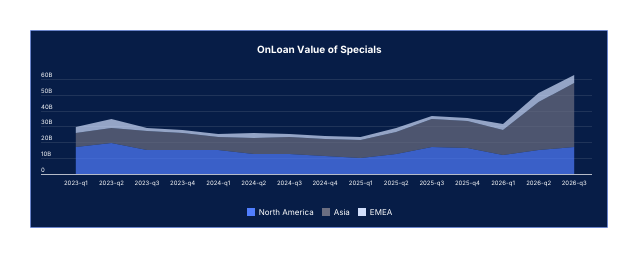
Demand remained elevated even as valuations continued to rise, and pricing continued to escalate because scarcity persisted. In North America the opposite occurred: specials balances were flat, lendable supply increased, and pricing fell as the extreme-fee names, like CoreWeave (CRWV US), of 2025 faded.
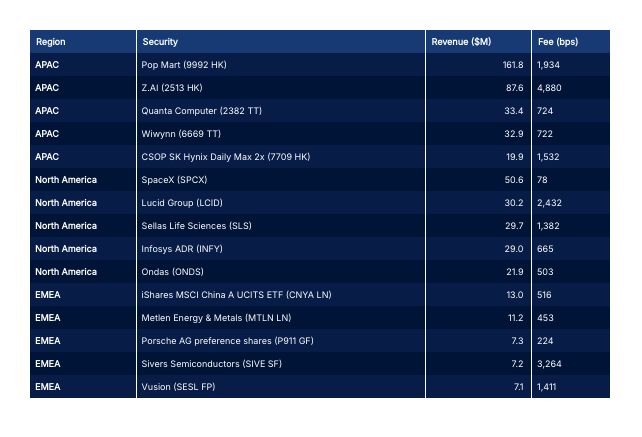
Asia’s top ten equities earned about 25% of the region’s equity revenue in Q3 2026, against about 18% in North America and about 17% in EMEA. The top five in each region were:
What’s in store for Q4 2026?
Historically, equity lending revenue fell from Q3 to Q4 in North America and Asia in each of the last three years, by an average of 20% and 6%, while EMEA was roughly flat. However, rising Treasury yields, heavy AI spending, and the Middle East conflict are creating highly volatile markets which can push short interest higher and borrow demand beyond its current highs.
Additionally, new supply from major IPOs, lock-ups and corporate actions can top the charts as they have in prior quarters. While dates are subject to change, Q4 has plenty of events in the historically calm quarter:
- AI-themed IPOs: Anthropic (US), Nscale (US), Switch (US), Moonshot AI (HK)
- IPO Lockup Expiration: SpaceX (SPCX US) ~Nov 9 and Dec 9, X-Energy (XE US) ~Oct 21, Cerebras Systems (CBRS US) ~Nov 10, Neutron Holdings (LIME US) ~Dec 28, and HK equities expected to unlock significant volume in December 2026
- Mergers: ZIM Integrated Shipping Services (ZIM US) & Hapag-Lloyd (HLAG DE), MiMedx (MDXG US) and Sanara MedTech (SMTI US)
The specials market diversifies
Q3 shows that the specials market is not simply getting bigger, it is becoming more varied in where opportunities emerge and what drives them. Asia’s rapid growth has been fueled by scarce new listings, tight floats and concentrated borrowing demand, while North America has experienced softer pricing and EMEA has continued to expand from a smaller base. Looking ahead, IPOs, lock-up expirations, mergers and other security-specific events could create fresh pockets of scarcity in Q4, reinforcing a market where the most significant lending opportunities are increasingly defined by individual catalysts rather than a single broad trend.