


Epic Fury, Meet Furious Shorts: Bears Waste No Time Piling In


When the U.S. and Israel began strikes on Iran on February 28th, 2026, it triggered what the International Energy Agency has since described as the “greatest global energy security challenge in history”. The near-total closure, followed by a blockade of the Strait of Hormuz, a narrow chokepoint through which roughly 20% of global oil supply and one-fifth of all LNG trade flows, did more than push Brent crude above $100 per barrel. It sent shockwaves through trading desks worldwide, reshaping borrowing patterns, driving elevated short interest in some of the market’s most prominent names, and exposing fault lines across sectors ranging from jet fuel to solar panels.
For securities lending participants, the conflict has created something rare: a fast-moving, multi-sector short-selling event driven by a single geopolitical catalyst. Our data across energy, airlines and utilities, tells a consistent story of rising valuations met with disciplined, tactical short positioning. This leads to a simple question every desk should be asking; are the shorts right?
Energy: The Infrastructure Trade and the Bet Against It
Few sectors have been re-rated as quickly and dramatically as oil and gas storage and transportation since hostilities began. As seaborne crude routes were disrupted and domestic North American infrastructure surged in strategic value, midstream operators and tanker names saw their equity valuations climb sharply. Our securities finance data tells the full story of rising prices, rising loan quantities, and a short-selling community making a very specific bet that the conflict ends quickly, and the premium evaporates with it.
ONEOK (OKE), a diversified energy company with a focus on natural gas, is the clearest illustration of this dynamic. At the start of the year, OKE was trading around $73–74 per share with approximately 26.2 million shares on loan and utilization, sitting at 9.68%. As the conflict escalated through February and into March, the stock climbed steadily, reaching $92.96 by March 30th with a gain of roughly 27% from January 1st. This price rally saw shares on loan surge to over 51.8 million by mid-March, representing a near-doubling of short interest from the start of the year with utilization climbing to 19.02%.
If the Strait of Hormuz reopens and U.S. domestic midstream infrastructure loses its scarcity premium, the stock could give back a meaningful portion of its gains. As ongoing ceasefire talks trigger an immediate relief rally across risk assets and send oil prices lower, these shorts may be well-positioned in the near term.
International Seaways (INSW), a marine shipping company with a focus on crude oil, presents an equally compelling data picture, but from the tanker side of the trade. INSW, one of the largest U.S.-flagged crude tanker operators, was a direct beneficiary of route disruption and surging spot rates on vessels operating outside the Persian Gulf. The stock moved from approximately $48–55 per share in early January to a peak above $76 in late February and early March, as the conflict intensified, representing a gain of over 40% at its high. Shares on loan climbed from roughly 1.4 million at the onset of the conflict to over 2.5 million by late March. The loan value itself surged from approximately $117 million at the start of the year to over $156 million by late March, reflecting both higher share prices and elevated borrow demand.
As with OKE, the short thesis is not a fundamental rejection of the business, it’s a duration call. Tanker rates are acutely sensitive to geopolitical risk premiums. If the conflict de-escalates and Hormuz flows normalize, the spot rates that have underpinned INSW’s valuation will compress rapidly. Shorts in this name are, in effect, selling the ceasefire trade before it happens.
Turbulence at 35,000 Feet: Airlines Feel the Heat of Rising Jet Fuel Costs
Few sectors wear the fingerprints of geopolitical disruption quite as visibly as commercial aviation. When conflict ignites in oil-producing regions, the knock-on effect moves swiftly through the supply chain and lands squarely on the airline industry’s single largest operating cost: jet fuel. With Brent crude spiking amid escalating Iran tensions, the short-selling community has responded with conviction, and our data makes the scale of that conviction impossible to ignore.
At the aggregate level, utilization across all passenger airlines rose from 7.8% at the start of January to 11.1% by the end of March, a jump of 3.3% over just one quarter. That rate of increase is significant as it reflects not merely opportunistic short selling in one or two names, but a coordinated, broad-based conviction trade against the sector.
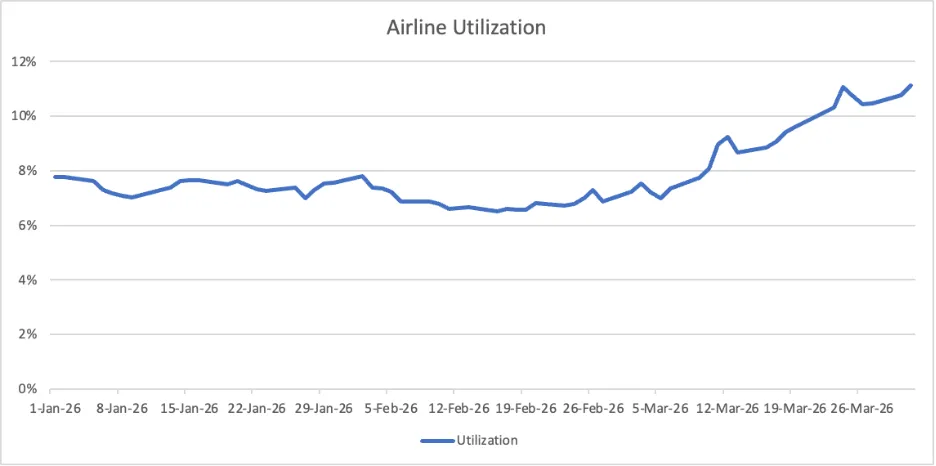
At the security level, the moves are even more striking. American Airlines (AAL) has seen shares on loan surge 228% to over 53 million, with its leveraged balance sheet leaving it acutely exposed to margin compression at current crude levels. Delta (DAL) and Alaska Airlines (ALK) round out the domestic picture, each seeing loan quantities roughly double over the quarter, reflecting a broad-based conviction trade across U.S. legacy carriers.
The pressure is equally acute internationally. EasyJet (EZJ LN) leads the pack with a staggering 3,340% increase in shares on loan over the period. Norwegian Air (NAS NO) tells a similar story with loan quantities up 1,407%, reflecting acute pressure on a carrier with limited balance sheet buffer to absorb a prolonged fuel shock. Japan Airlines (9201 JP) has seen loan quantity growth of 853%, pointing to deeply convicted short positioning in the Asia-Pacific market. Lufthansa (LHA GR) rounds out the international picture with borrowing activity up 314%, as European carriers face the dual burden of fuel cost inflation and potential airspace rerouting costs tied to the conflict.
| Ticker | Security | Loan Quantity - Jan 1 | Loan Quantity - 31 Mar | % Change |
|---|---|---|---|---|
| EZJ LN |
|
easyJet
|
1,739,784
|
59,852,218
|
3340%
| |
NAS NO
|
Norwegian Air Shuttle
|
2,536,896
|
38,241,916
|
1407%
| |
9201 JP
|
Japan Airlines
|
2,866,597
|
27,331,421
|
853%
| |
LHA GR
|
Lufthansa
|
12,665,022
|
52,410,589
|
314%
| |
AAL
|
American Airlines
|
16,198,991
|
53,175,115
|
228%
| |
QAN AU
|
Qantas Airways
|
4,803,843
|
14,099,842
|
194%
| |
DAL
|
Delta Airlines
|
11,582,933
|
23,772,259
|
105%
| |
AIR NZ
|
Air New Zealand
|
9,112,728
|
18,503,671
|
103%
| |
ALK
|
Alaska Airlines
|
7,902,947
|
15,615,682
|
98%
| |
UP
|
Wheels Up Experience
|
8,740,102
|
16,681,362
|
91%
|
Utilities: The Safe Harbor Under Siege
Utilities have long served as the market’s security blanket; the sector investors flee to when geopolitical storms darken the horizon. Traditionally characterized by stable dividends, regulated revenue streams, and inelastic demand, utilities should be thriving right now. On the surface, that holds true, but beneath the calm, securities finance data tells a more complicated story.
NextEra Energy (NEE), the largest U.S. utility by market cap, has seen its shares climb as high as over $95, up 18%, reflecting investor appetite for defensive exposure. At the same time, loan quantities have climbed steadily through Q1 2026 from a low of 15.2 million to as high as 42 million shares. The market is simultaneously buying the safety narrative while betting against the valuation stretched by it.
Xcel Energy (XEL) tells a similar tale. With shares trading in the low $80s, up almost 15%, and a market cap approaching $52 billion, XEL has seen loan quantities surge, peaking at 31 million shares on loan as of late March, up from a low of 10 million in mid-February.
The Bottom Line
The Iran conflict has handed the securities finance market one of its most active short-interest environments in years. Across energy infrastructure, aviation, and utilities, the pattern is consistent: rapid valuation moves driven by geopolitical fear, met with disciplined short selling positioned for a return to normalcy. The shorts are wagering that when a ceasefire holds, the Strait reopens and the risk premium deflates.

